Breaking Ground for HAFUN: Hamburg’s New Hub for Fundamental Physics
20.01.2026
The new research facility will enable innovative experiments in gravitational physics and serve as a platform for global scientific collaboration.
Construction of the Hamburg Fundamental Interactions Laboratory (HAFUN) officially began with a ceremonial first groundbreaking. Once completed, the new facility will bring together around 200 researchers from the Cluster of Excellence Quantum Universe, the Department of Physics and the MIN Faculty at the University of Hamburg. They will use cutting-edge infrastructure to explore fundamental questions in particle physics and cosmology.
„With HAFUN we are creating ideal laboratories for fundamental research. Special labs for experimental gravitational wave detection on ground and in space are one of the highlights. We will be able to use the ultra low-noise underground facilities to study technologies for the Einstein Telescope low-frequency detector and beyond. By equipping the building and the campus with a dense seismic and acoustic sensing network we also create an ideal environment to study the mechanical and gravitational coupling of the surroundings into our instruments. HAFUN will be an ideal place for testing new concepts in experimental gravitational physics and for international collaboration.“
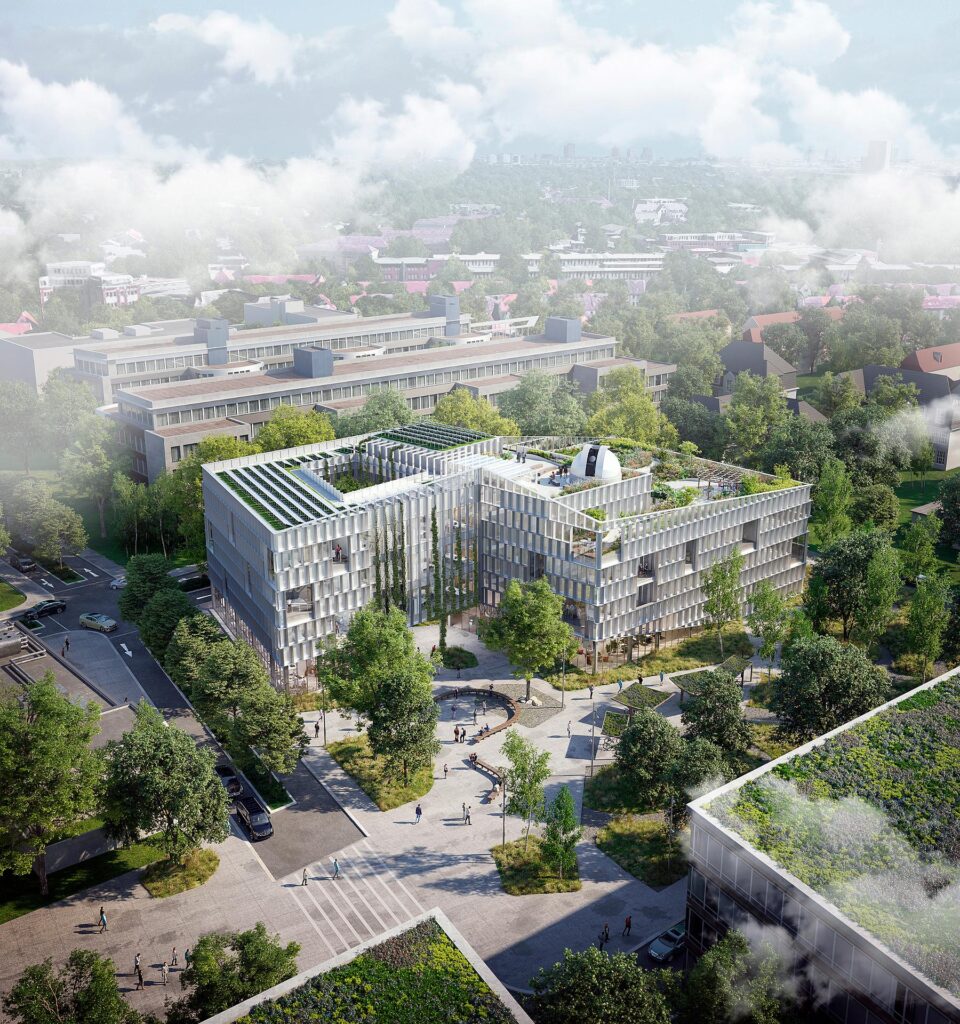
Credit: C.F. Møller Architects
Further links:
https://www.uni-hamburg.de/newsroom/campus/2026/0119-spatenstich-hafun.html
https://www.physik.uni-hamburg.de/en/iexp/gruppe-gerberding.html
https://www.physik.uni-hamburg.de/en/iqp/ag-schnabel.html
https://www.geo.uni-hamburg.de/en/geophysik/forschung/seismology.html
https://www.hsu-hh.de/mt/en/team/260-2/
Erster Spatenstich für HAFUN: Hamburgs neues Zentrum für Grundlagenphysik
Die neue Forschungseinrichtung wird innovative Experimente in der Gravitationsphysik ermöglichen und zugleich als internationale Plattform für wissenschaftliche Zusammenarbeit dienen.
Mit einem feierlichen ersten Spatenstich wurden die Bauarbeiten für das Hamburg Fundamental Interactions Laboratory (HAFUN) offiziell eingeläutet. Künftig werden hier rund 200 Wissenschaftlerinnen und Wissenschaftler des Exzellenzclusters Quantum Universe sowie des Fachbereichs Physik und der MIN-Fakultät der Universität Hamburg grundlegende Fragen der Teilchenphysik und Kosmologie mit modernster Infrastruktur erforschen.
„Mit HAFUN schaffen wir hervorragende Laborbedingungen für die Grundlagenforschung“, heißt es aus dem Projekt. Zu den zentralen Elementen zählen spezialisierte Labore für die experimentelle Detektion von Gravitationswellen – sowohl auf der Erde als auch im Weltraum. Die ultra-rauscharmen unterirdischen Anlagen sollen es ermöglichen, neue Technologien für den Niederfrequenzdetektor des Einstein-Teleskops und darüber hinaus zu erproben.
Darüber hinaus wird das Gebäude ebenso wie der gesamte Campus mit einem dichten Netz seismischer und akustischer Sensoren ausgestattet. So entsteht ein ideales Umfeld, um zu untersuchen, wie mechanische und gravitative Einflüsse aus der Umgebung auf hochsensible Messinstrumente wirken. HAFUN soll damit nicht nur neue Konzepte in der experimentellen Gravitationsphysik vorantreiben, sondern auch die internationale Zusammenarbeit in diesem Forschungsfeld weiter stärken.
Weiterführende links:
https://www.uni-hamburg.de/newsroom/campus/2026/0119-spatenstich-hafun.html
https://www.physik.uni-hamburg.de/iexp/gruppe-gerberding.html
https://www.physik.uni-hamburg.de/iqp/ag-schnabel.html
https://www.geo.uni-hamburg.de/geophysik/forschung/seismology.html
https://www.hsu-hh.de/mt/231-2/